Drew Becker · 1 October 2026
Nutrient Exchange Patterns Among Native Shrubs and Their Effects on Long-Term Soil Stability in Isolated Ecosystems
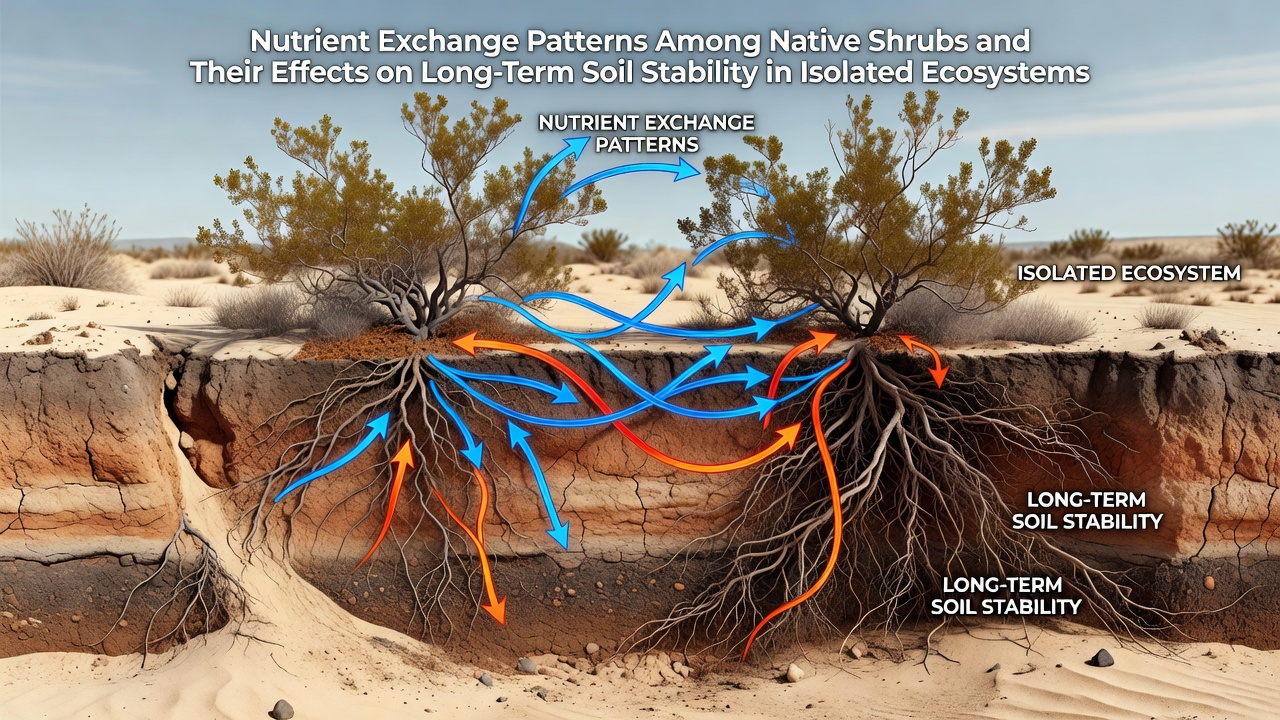
Native shrubs in isolated ecosystems develop intricate nutrient exchange patterns that sustain soil stability over extended periods, and researchers continue to document these processes across remote habitats where external inputs remain minimal. These patterns rely on root systems that interact with soil microbes and neighboring plants, creating pathways for nitrogen, phosphorus, and carbon movement that reduce erosion risks in fragile landscapes. Data from field measurements shows that such exchanges often concentrate organic matter near shrub bases, which in turn anchors topsoil layers against wind and water displacement.
Mechanisms of Nutrient Transfer in Shrub Communities
Shrubs facilitate nutrient transfer through mycorrhizal associations and direct root contacts, while leaf litter decomposition releases stored elements back into the surrounding matrix at rates that vary with seasonal moisture availability. Studies indicate that certain species form common mycorrhizal networks linking multiple individuals, allowing carbon compounds to move from donor plants to receivers during periods of stress, and this connectivity strengthens overall community resilience in places where soil nutrients occur in patchy distributions. Evidence from long-term monitoring plots reveals that phosphorus uptake increases when shrubs share fungal partners, yet the efficiency depends on soil pH and temperature fluctuations that affect microbial activity.
Isolated ecosystems such as high-altitude plateaus and coastal dunes demonstrate these transfers most clearly because limited animal vectors and infrequent rainfall restrict alternative nutrient sources. Observers note that shrub canopies trap wind-blown particles containing trace minerals, and root exudates then solubilize these materials for uptake, creating localized fertility hotspots that expand slowly over decades. Recent sampling conducted through October 2026 confirmed elevated nitrogen fixation rates in leguminous shrub stands compared with adjacent bare ground, supporting the observation that these plants actively modify their immediate chemical environment.
Impacts on Soil Structure and Erosion Control
Long-term soil stability emerges when nutrient cycling reinforces aggregate formation, and roots bind particles into stable clumps that resist detachment during heavy precipitation events. Research indicates that shrubs with dense lateral root mats reduce surface runoff velocity, allowing more time for infiltration while simultaneously depositing organic residues that bind clay and silt fractions. In regions where isolation limits external sediment supply, this internal reinforcement becomes essential for maintaining soil depth against gradual weathering forces.
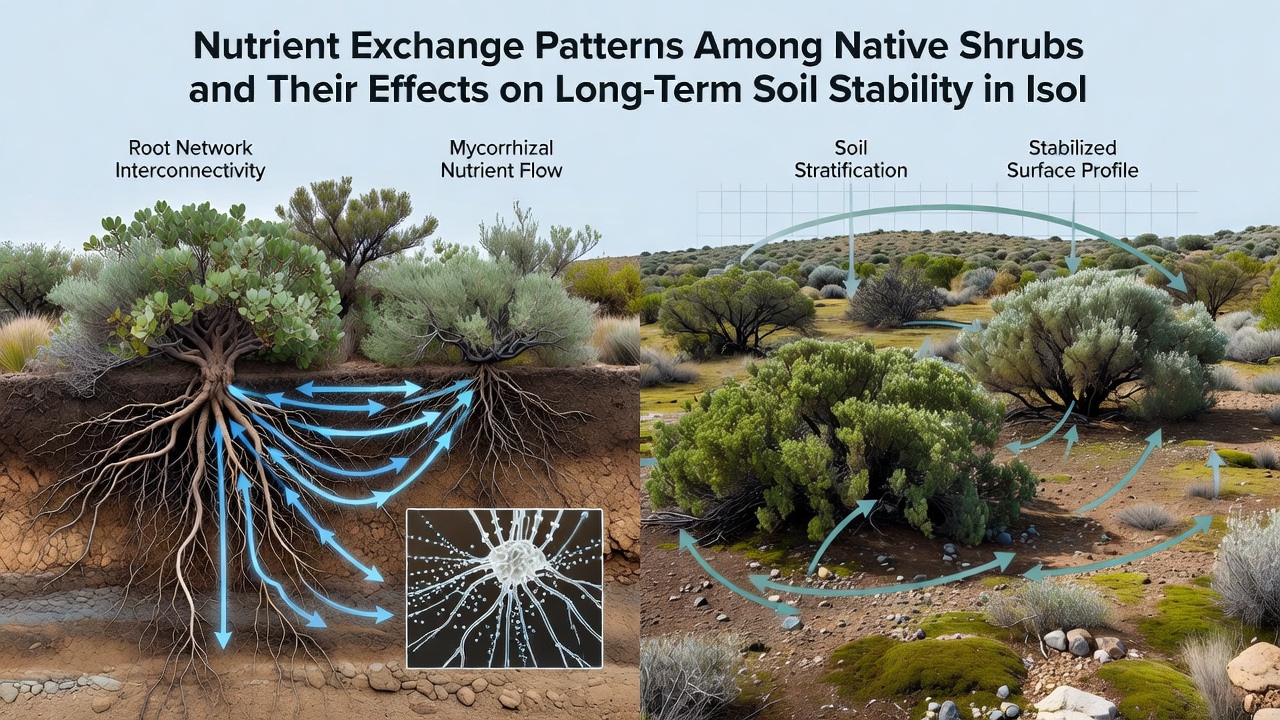
Measurements taken across multiple sites show that areas dominated by native shrubs maintain higher soil organic carbon levels than comparable open spaces, and this difference correlates with reduced bulk density and improved water-holding capacity. Australian government reports from the Department of Climate Change, Energy, the Environment and Water document similar patterns in arid zone reserves where shrub removal led to measurable increases in sediment loss within five years. The same datasets highlight how nutrient redistribution from deeper soil layers to surface horizons supports microbial populations that further cement soil particles through polysaccharide production.
Case Examples from Remote Habitats
One documented example comes from subalpine shrublands in the Canadian Rockies, where researchers tracked nutrient gradients around individual plants and found that stability indices remained elevated even after successive drought cycles. Another study in the Scottish Highlands examined dwarf shrub communities on nutrient-poor granite substrates, revealing that exchange networks maintained phosphorus availability at levels sufficient to prevent widespread dieback. These cases illustrate how isolation amplifies the importance of internal cycling, since external inputs arrive infrequently and in small quantities.
Additional observations from Mediterranean-type shrublands in South Africa indicate that proteoid shrubs enhance iron and manganese mobilization through specialized cluster roots, and the resulting nutrient pulses support surrounding vegetation that contributes additional litter inputs. Data collected by the South African National Biodiversity Institute shows that sites retaining intact shrub cover experienced 40 percent less gully formation over a 15-year interval than cleared control areas. Such patterns underscore the cumulative effect of sustained exchange processes on landscape integrity.
Recent Monitoring and Broader Implications
Monitoring programs initiated in the early 2020s have expanded to include remote sensing of vegetation indices combined with ground-based soil sampling, and results released in October 2026 from collaborative projects involving the US Geological Survey and European research consortia confirm that shrub density directly predicts long-term soil retention metrics across several isolated test regions. These findings integrate with earlier work showing that alterations in shrub composition, whether from climate shifts or disturbance, can shift nutrient flow directions and thereby influence erosion rates over subsequent decades.
Links between above-ground biomass and below-ground stability continue to receive attention because changes in one component propagate through the exchange network. Figures compiled by the Commonwealth Scientific and Industrial Research Organisation demonstrate that shrub-driven nutrient hotspots expand at measurable rates when disturbance intervals exceed typical fire or drought cycles, allowing cumulative improvements in soil physical properties. Continued observation across additional isolated systems will clarify how these dynamics scale under varying isolation intensities and climatic regimes.
Conclusion
Nutrient exchange among native shrubs sustains measurable improvements in soil stability within isolated ecosystems through interconnected root and microbial pathways that redistribute essential elements and reinforce physical structure. Evidence accumulated from multiple continents indicates these processes operate most effectively when shrub communities remain intact and disturbance regimes permit gradual accumulation of organic matter. Ongoing data collection through programs such as those coordinated by the US Geological Survey and CSIRO will refine understanding of threshold conditions that either maintain or disrupt these stabilizing functions over extended time scales.